A home becomes a household
Shelter, food, water, warmth, belongings, money, obligations, and relationships turn a building into a place someone has reason to return to.
 Worldforge
A world with its own errands
Now forging
First Settlement
Worldforge
A world with its own errands
Now forging
First Settlement
Open-world settlement RTS / RPG
People work, remember, form households, take risks, and build a place worth defending. Watch the ordinary days. Step in when a day stops being ordinary.
Production roadmap
Compose the completed systems into one small settlement that visibly works, struggles, and responds to player direction.
Hover, focus, or tap a milestone to read its purpose.
Worldforge is about governing a settlement whose inhabitants are people, not worker tokens.
Villagers choose work, carry goods, make plans, remember outcomes, form bonds, and react to danger through the same world rules whether the player is watching or miles away. A bridge, a shortage, a bad road, or a missing friend can matter for more than one afternoon.
The player observes first. Set priorities, assign work, organize a party, or explicitly take control of someone when precision matters. Once released, that person returns to autonomous life with every bruise, favor, promise, and sack of turnips intact.
A settlement from the inside out
Growth is not a ladder of bigger labels. A settlement becomes capable because real people, material, knowledge, infrastructure, and trust are present—and can lose those capabilities when life goes badly.
Shelter, food, water, warmth, belongings, money, obligations, and relationships turn a building into a place someone has reason to return to.
Trees do not become houses by appearing in a counter. Somebody finds them, claims the work, cuts them, hauls them, reserves them, and builds with them.
One town may fund a forge. Another may choose a tavern, shrine, granary, watchtower, or nothing sensible at all. Prosperity is possible. So is decline.
A settlement at a glance
Every person, priority, storehouse, route, and distant concern has a place. Keep the whole settlement in the palm of your hand—and reach in when it needs you.
Hearthvale · Early Autumn · Day 42
Household ledger
People retain their identity, possessions, relationships, memories, obligations, and plans whether they are nearby or far from the camera.
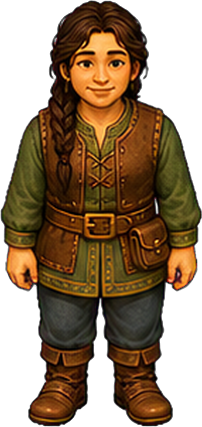
Cautious, sociable, tired of rain
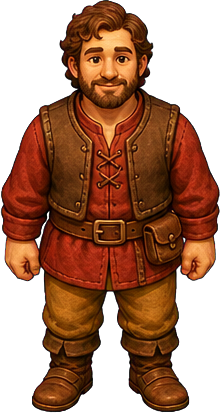
Steady, practical, owes Mara a favor
Trust grew after the northern-road rescue.
Committed to repair the roof before first frost.
Fuel reserve is becoming a shared concern.
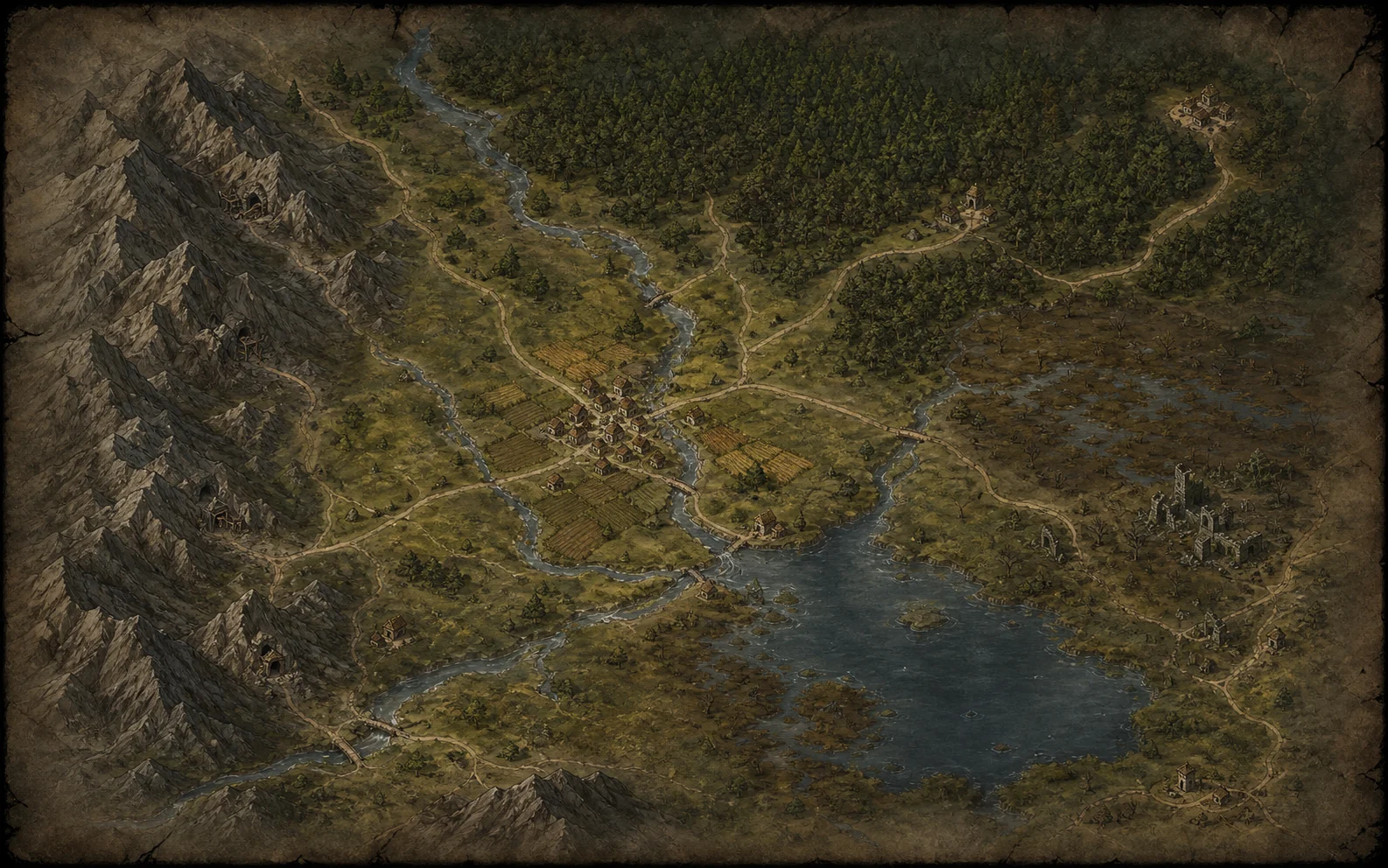
Cooper22 food · 3 fuel
Alder16 food · 8 fuel
Vale9 food · 5 fuel
Fuel gatheringUrgent
Roof repairCommitted
SmokehouseProposed
Iron deliveryPending
Wool purchaseFunded
Autumn market12 days
Interface studies show intended presentation and planned content breadth. Final art and layout will continue to evolve.
Choice with a paper trail
Each person weighs needs, danger, duty, opportunity, memory, and temperament across a flexible utility model. The winning intent becomes an inspectable plan, then real steps in the world. Hunger matters—but so does finishing the roof before the rain.
A frightened scout may refuse a routine trip. A master craftsperson may finish work quickly. Someone carrying lunch may keep working. Someone heartbroken may not. The important part is that the same rules produce the decision, and the player can understand why.
Your hand, when it matters
Clicking a person never hijacks their life. Observe them, inspect what they know, or assign work while they remain autonomous. Take direct control only when a hunt, journey, defense, or bad idea deserves your full attention.
Follow a life without changing it.
Give intent. The world still owns the work.
Move directly, lead a party, and own the consequence.
They return to their plans with the outcome intact.
Lua interface addons
Worldforge’s versioned Lua API can inspect villagers, households, jobs, resources, buildings, fields, roads, fences, construction, and maintenance through detached queries. Packages can compose movable panels, listen for completed events, and submit the same validated work, priority, construction, infrastructure, money, movement, and control requests used by the standard interface. Packages reload without restarting the game; faults remain isolated while the simulation continues. Every registered symbol is listed in the public Lua API Reference.
Food236
Timber184
Stone91
Firewood26 ↓
Affected2 households
Horizon3 days
Try dragging the addon panels.
function draw_ledger()
  local stock = world.query(
    "world.resource.counts",
    { page_size = 16 }
  )
  assert(stock.status == "completed", stock.detail)

  ui.begin_panel({
    id = "hearth-ledger",
    title = "Hearth Ledger",
    anchor = "top-left",
    movable = true,
    semantic_label = "Settlement resources",
    semantic_role = "status"
  })

  for _, item in ipairs(stock.records) do
    ui.row(item.key, tostring(item.total))
  end

  ui.end_panel()
endA broad world, selectively alive
Nearby people move and work in detail. Distant settlements, travelers, routes, weather, ecology, trade, and conflict continue at the fidelity their consequences require. Identity and causality persist even when the camera is elsewhere.
Inside the workshop
Worldforge spent years as notes, prototypes, system sketches, and stubborn questions. Production now moves through small, proven phases, supported by tools built around the project rather than scattered documents and one-off asset work.
Keeps design decisions, current engine behavior, phase ownership, proof, and future work connected as the project grows.
Organizes templating, masking, directional variants, consistency checks, and repeatable asset preparation for a world that needs a great many small things.
Built in C++ and SDL around deterministic simulation, streaming space, persistent identities, recoverable saves, reproducible proof, and a player interface that can change without recompiling the game.
A lifelong project, finally in production
Worldforge draws inspiration from the systemic consequence of Dwarf Fortress, the readable command language of Age of Empires, the grand presentation of Endless Space 2, and the attachment that grows inside long-lived MMO worlds.
The result is its own peculiar thing: part settlement sim, part RTS, part personal RPG, and part careful attempt to find out how many turnips a believable civilization actually needs.